The Ivolginski datsan is situated in the picturesque Ivolga
surrounding, at the foot of the mountains, in the silent place 35 km from the capital of
Buryatia Ulan-Ude.
 The Ivolginski datsan was founded in
1946. At the beginning and for a long time the datsan had the status of half a museum. All
necessary services were conducted, but there wasn’t any education. For a long time if
was one of two acting datsans in the whole territory of the Soviet Union. The second is
situated in the village of Aginskoye, in Chita Region.
The Ivolginski datsan was founded in
1946. At the beginning and for a long time the datsan had the status of half a museum. All
necessary services were conducted, but there wasn’t any education. For a long time if
was one of two acting datsans in the whole territory of the Soviet Union. The second is
situated in the village of Aginskoye, in Chita Region.
By 1958 Ivolginski datsan was isolated and comfortable town with wooden buildings
for the priests and part for the laymen. All the buildings are electrified and equipped
with the radio, datsan has communication with the Ivolga and with the capital of the
Republic. The territory is fenced and planted in trees and gardens. A big book depository
for the Buddhist literature and religious items is built.

In 1958 the hotel was started to be build. In 1967 the Indian
delegation with the directorof the International Academy of Indian culture Lokesh Chandra,
the employees Sharada Roni and Kailash Chandra, Cambojia delegation with pro-rector of the
Buddhist University in Pnompehn monk Pon Compkhean, Ceylon delegation with the priest
Bipulosar Tkhero, Sikkim delegation. Queen of the this princedom Kyanazang Tsomo. Lockesh
Chandra presented to the Ivolginski datsan completeworks of the Buddhist canon –
Gandzhur, translated info Old Mongolian language. At present Gandzhur is kept in the
museum of the Ivolginski datsan. The gifts made by other delegation are also there.
 Eventually from the small
“Hambo sume” it was changed into monastic complex with the residence of the
Hambo-lama, the head of the Russia’s Buddhists. The names of the Hambo-lamas Darmaev
Lubsan-Nima, Sharapov Eshi-Dorzhi, Gomboev Zhambal-Dorzhi, Erdineev Zhimba are known among
the Buddhists of the world, who put much energy into the development of Buddhism in
Russia. Traditionally building of datsan itself is arranged in order that entrance must be
from the south. It is accounted for the altar, which is situated opposite the entrance
must be situated in the northern place, as according to conception of buddhists exactly in
the north there is the Buddha’s land, where there is Buddha Shakyamuni right now. The
door on the roof there chakra are two deer kneeling before a wheel. The main meaning of
this figure is in following historical fact. In ancient times one of the gods, Esrya
offered the Buddha the wheel with a thousand spokes, made of gold and asked him to start
his sermon. When the Buddha spoke, two goldish deer, male and female, run out of the
forest, listened to the Buddha reading, watching at the top of the wheel. Vigilant and
tireless because non-intelligent beasts are trying to understand him. Near the entrance of
the datsan there are defenders of four parts of the world. They must defend the datsan
from all harmful influences.
Eventually from the small
“Hambo sume” it was changed into monastic complex with the residence of the
Hambo-lama, the head of the Russia’s Buddhists. The names of the Hambo-lamas Darmaev
Lubsan-Nima, Sharapov Eshi-Dorzhi, Gomboev Zhambal-Dorzhi, Erdineev Zhimba are known among
the Buddhists of the world, who put much energy into the development of Buddhism in
Russia. Traditionally building of datsan itself is arranged in order that entrance must be
from the south. It is accounted for the altar, which is situated opposite the entrance
must be situated in the northern place, as according to conception of buddhists exactly in
the north there is the Buddha’s land, where there is Buddha Shakyamuni right now. The
door on the roof there chakra are two deer kneeling before a wheel. The main meaning of
this figure is in following historical fact. In ancient times one of the gods, Esrya
offered the Buddha the wheel with a thousand spokes, made of gold and asked him to start
his sermon. When the Buddha spoke, two goldish deer, male and female, run out of the
forest, listened to the Buddha reading, watching at the top of the wheel. Vigilant and
tireless because non-intelligent beasts are trying to understand him. Near the entrance of
the datsan there are defenders of four parts of the world. They must defend the datsan
from all harmful influences.
The building of datsan is used for all services. Daily services are held every day
from 9 to 11 o’clock a. m. All lamas of the datsan gather this khural, they sit
according to seniority – senior closer to altar, junior – closer to exit. Lamas
start praying all together at the same time and are accompanied by blows of drums, sounds
of shells, rings of bells and kettle drums. Lamas accomplish the service with different
rituals, for example, scatter grains, make bows.
. In
keeping with tradition, six major holidays, khurals, are celebrated annually. Usually they
last three days, prayers are read from morning till evening. People from far away
districts, towns and villages come to such holidays. The greatest holiday is meeting the
Buddhist New Year, which is celebrated on first day of the first month in the lunar
calendar. This holiday is called the holiday of the White month.
In
keeping with tradition, six major holidays, khurals, are celebrated annually. Usually they
last three days, prayers are read from morning till evening. People from far away
districts, towns and villages come to such holidays. The greatest holiday is meeting the
Buddhist New Year, which is celebrated on first day of the first month in the lunar
calendar. This holiday is called the holiday of the White month.
There are 4 stupas on the territory of the datsan. The tradition
of building stupas started in India from the time of Buddha Shakyamuni’s life, as
monuments of remarkable sacred events. Later stupas were erected not only on the places of
remarkable events but also served as tombs for lamas, famous for holiness of their lives
and their feats for the sake of Buddhist faith. Stupas are the objects of worship as
pictures of deities, dugans (small temples) and etc.
Besides, there is a special conservatory with “Bodhi
Tree”. Under the same tree Buddha attained Enlightenment in India.

There are three doctors-tibetoligists in the Ivolginsky datsan.
The power of Tibetian medicine is in that it is orienteated on symptomocomplexes of
patient and tenderly reacting on the group of symptoms it pays attention to the
complaints. Tibetian medicine is closely connected with astrology. Purveyance of raw
materials for medicine, prescription of Tibetian diets, beginning of treatment and etc.
are fixed according to astrological datas. In complicated cases, doctor, using astrology
can define methods, whether the treatment is worth starting.
Tibetian asrology is synthesis of Indian and
Chinese traditions. It is widely spread in Tibet, Mongolia, Buryaria, Kalmykia and Tuva.
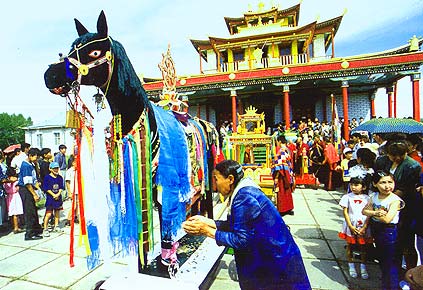
Datsan is protected by the state as a monument
of cult architecture
Nowadays the Ivolginsky datsan is the center of
Buddhism in Russia,
attracting many pilgrims and tourism